

Inside the Artroom No. 001 - Meet the maker behind the Poison Brew Tea Pot
February 25, 2026
Inside the Artroom: The Poison Brew Tea Pot
Every piece begins with obsession. Meet Stuart, Principal Artist at Alchemy of England.
Some ideas refuse to stay dormant. The Poison Brew Tea Pot first appeared years ago as artwork on a ceramic coaster - a passing thought, a sketch filed away. But certain images have a way of returning, insistent, when the time is right.
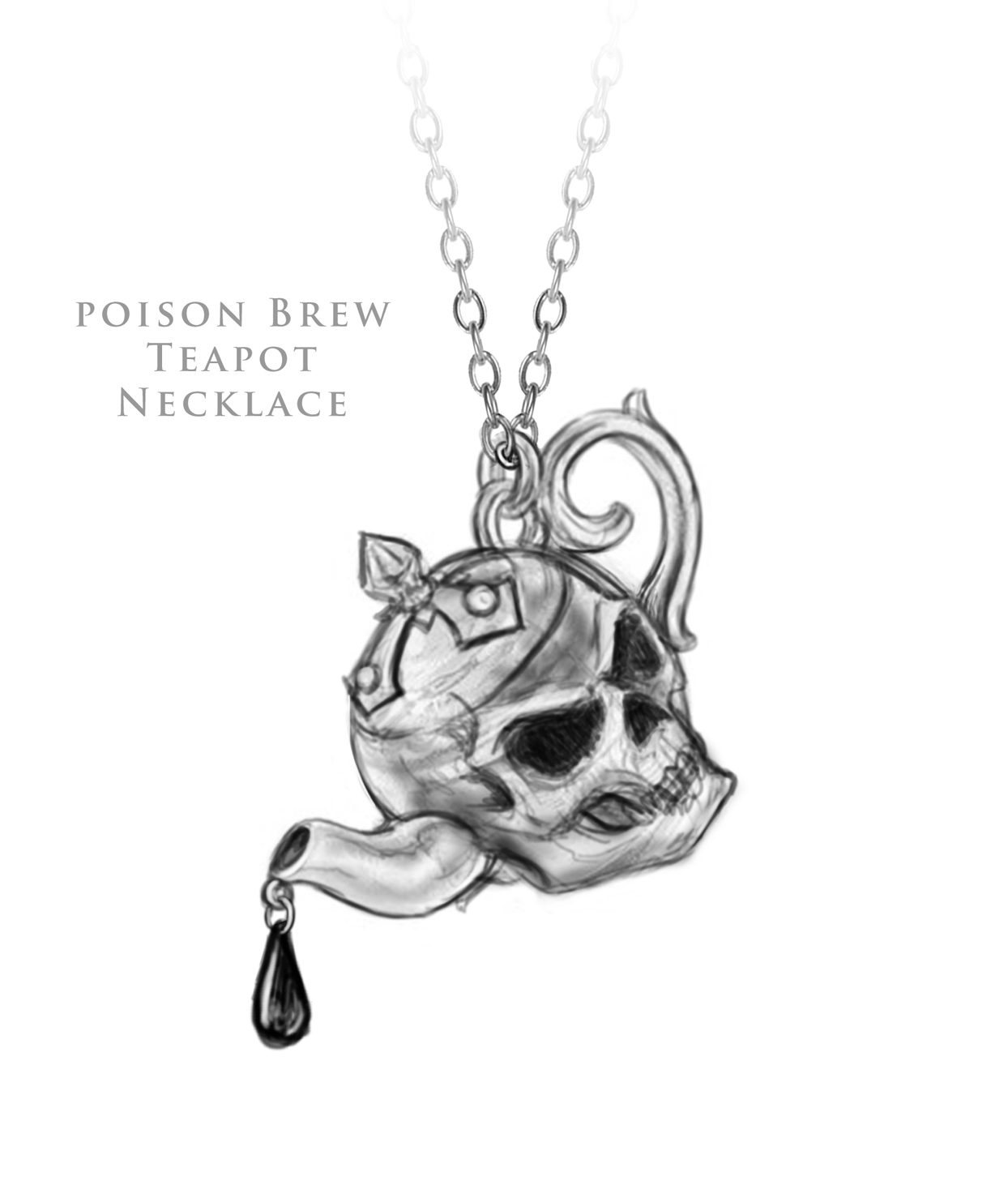
When Stuart began exploring how ordinary domestic objects could be twisted into dark gothic jewelry, the teapot surfaced again. Delicate enough to feel decorative. Macabre enough to unsettle. And behind it, a history he could not ignore.
The History That Refused to Let Go
Poison has always been the weapon of the seemingly powerless. From Renaissance Italy to Victorian England, it was the art of those who could not wield swords but knew how to wait, how to pour, how to serve death in a teacup.
In the Victorian era, poison was everywhere - arsenic in cosmetics and wallpaper, strychnine for pest control, laudanum in nurseries. Arsenic was called "the king of poisons," sold as rat poison and flypaper in every grocery and drug store. It gave no taste, no smell, no warning. Symptoms mimicked common illness. And it could be administered slowly, carefully, over months.
Women like Madeleine Smith soaked flypapers to extract arsenic and served it in cocoa. Mary Ann Cotton poisoned four husbands and twice as many children. Adelaide Bartlett's husband died with a stomach full of chloroform, though no trace touched his mouth or throat - a mystery that baffled the court.
Further back, in 17th century Italy, Giulia Tofana invented Aqua Tofana, an arsenic solution disguised as cosmetics, which she sold to women trapped in brutal marriages. Legend claims she confessed to killing 600 men. Agrippina the Younger was reputed to have poisoned her husband, Emperor Claudius, to secure the throne for her son Nero - who later had her executed. The poison was said to have been provided by Locusta, a professional poisoner.
The teapot became the perfect vessel for this dark history. Domestic. Innocent. The ritual of afternoon tea transformed into something far more sinister - a fitting inspiration for alternative jewelry that tells stories Victorian society tried to forget.
From Sketch to Metal
Stuart does not work alone. Behind every handcrafted pewter piece is a small team of artisans - sculptors, mold makers, casters, finishers - each with a hand in the transformation from clay to metal.
The process begins with clay. Stuart sculpts the original model by hand, refining the teapot's curves, the menacing grin of the skull lid, the delicate handle and spout. Once the clay model is complete, a room temperature vulcanizing (RTV) mold is made, as clay cannot withstand the temperature and pressure of standard vulcanizing. From the RTV mold, new models are cast in high-temperature resin.
The resin model is then set into raw rubber and vulcanized - heated under pressure to around 350°F until the rubber liquefies and conforms to the model, creating an exact replica. The mold is gated (where the metal enters) and vented (where air escapes). Proper mold design is critical - the piece must release cleanly once cast.
The raw materials - tin, copper, and antimony - are cut and heated to 350°C until molten. The liquid pewter is poured into the mold with extreme care. For smaller pieces like handmade gothic jewelry, the mold spins inside a casting machine, using centrifugal force to push the molten metal into every detail of the cavity.
Once cooled, the piece is extracted. Superfluous lumps and bumps leftover from the casting process are removed. Then begins the hand finishing - filing, drilling, burnishing, soldering, polishing by hand before final machine polishing. The teapot's bail and chain are attached. Every edge is smoothed. Every surface inspected.
It is painstaking work, requiring patience and precision from every member of the team.
Stuart's Account
"At first this seems like a ridiculous idea but it fitted nicely into that 'cute and creepy' school that Alchemy sometimes dips its boney toe into. The idea had occurred to me initially some years ago when it served as an artwork image on a ceramic coaster. The idea then popped to the surface again when I started to think of ordinary domestic objects that we could somehow twist into dark unsettling jewelry.
Instantly, the story of gruesome true-life poisoners down the centuries seemed like the perfect fit."
The Finished Piece
The Poison Brew Tea Pot Pendant hangs as both decoration and warning. Handcrafted in fine English pewter, the teapot's grinning skull lid suggests exactly what might be brewing inside. This unique skull jewelry piece sits in that precarious balance Alchemy returns to again and again - beautiful enough to wear, unsettling enough to make people look twice.
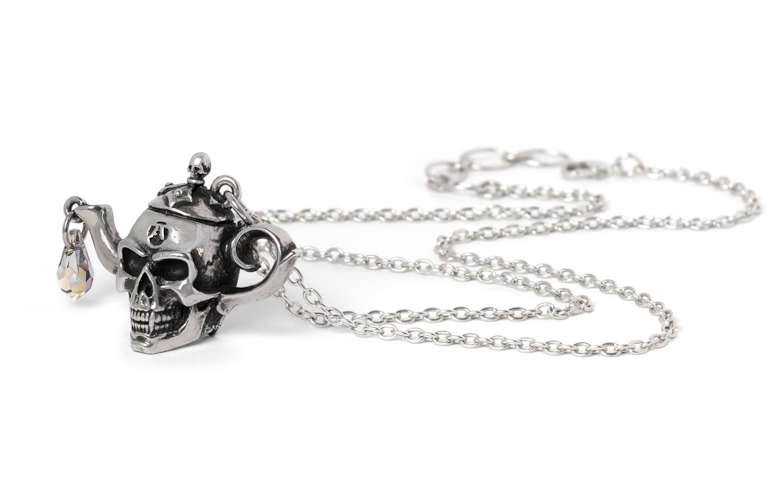
It is not for everyone. But for those who understand that darkness and elegance are not opposites, the Poison Brew Tea Pot offers a wearable reminder that the most dangerous things often arrive in the most innocent forms. Like all Alchemy gothic pendants, it carries meaning beyond its material - a conversation between history, craft, and the wearer who chooses to tell that story.
SHOP THE POISON BREW TEA POT PENDANT→